|
|
Drill tests regional disaster response |
| By By LESLIE ROVETTI | |
| September 13, 2009 | |
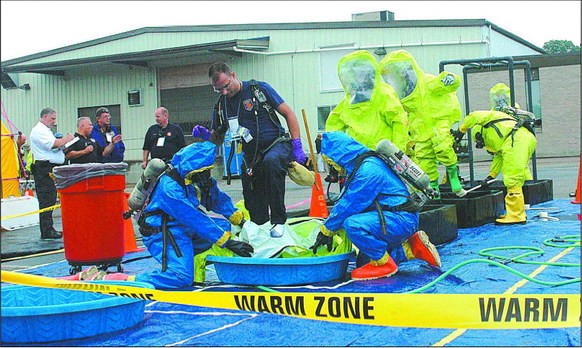
| N. STONINGTON — Emergency responders suited up in spaceman- like gear Saturday to wander through the hazy hallways of the Contract Chemical Manufacturing Co., looking for victims of a massive chemical spill. Their encapsulating level-A hazmat suits were air-, liquid- and vapor-tight to protect them from what appeared to be an acid spill. The suits are cumbersome and hot, so each team of responders had only about 13 minutes to walk through the building, carrying extrication gear and a stretcher. Grim-sounding stuff, only it wasn't true. There is no Contract Chemical Manufacturing Co., and there was no spill. It was a mock
Although emergency response units conduct regular drills, Richard Morris of the Connecticut Incident Management Team said it's the first large interstate drill in this area of the state in a long time. It brought together teams of fire, ambulance, police and other specialty units from local towns, the two states and the federal government. Seven victims — actually volunteer actors playing victims — walked out of the building and into the decontamination tent brought by the Westerly Fire Department. Three other victims pretended to be injured, and had to be rescued. The tent was set up to accommodate victims whether they walked in on their own or were wheeled in. To be decontaminated, a victim would have to remove all clothing and personal belongings like glasses and jewelry and place them in a bag for later decontamination. Next, they walked into a shower area with both spray and mist. There was a portable heater to make the water a little more pleasant, said Chief David Sayles of the Westerly Fire Department, and the nature of the contaminant would determine what goes into the water. It might be soap, he said, or bleach, or just plain water. Water for the decontamination tent is typically provided by the home fire department, he noted, and in this case it was North Stonington fire trucks filling up the water tanks. The last section contained kits with towels, disposable clothing, and antibacterial hand wipes. Although the tent was about 10 feet wide and 25 feet long, Sayles said it can compress into a fourfoot- by-four-foot cube, and will set up in just minutes. "It's ideal," he said. "It's quiet, efficient. We've used it numerous times, and it's still in good shape." Sayles said the department has about a dozen haz-mat technicians, but only three were at the drill. "We still have the town to protect," he noted. And while the Westerly unit was there, the Kingston decontamination unit was backing up Westerly. "The community's always covered," he said. Outside the staging and decontamination area, other actors were playing their parts in the disaster. Former WJAR-10 reporter Leslie Yeransian pretended to interview an emergency responder, asking him about evacuations and what people should do. At the end, she asked a question she probably never asked before. "So, what did you make up?" she asked with a big grin. Nearby, the red, white and blue Rhode Island Emergency Management Mobile Command Center was parked on the road. "I'm just here to deploy radios," said Paul Budzenski, who was stationed behind a desk in the modified recreational vehicle. He said he and Mike Walsh handled communications and logistics for the Rhode Island teams. Among the electronic tools in the command center was WebEOC, crisis management software in which all requests and actions are logged. It is available to any authorized user, Budzenski said, from state workers to the president of the United States. Theoretically, he added, it could allow someone to monitor or even coordinate a disaster from a distant location. "It's the coolest use of technology," he said. Among those using WebEOC on Saturday were those who staffed North Stonington's emergency operations center in New Town Hall. WebEOC was prominently displayed on a 46-inch computer monitor, and Emergency Management Director Phil Baumann kept his eye on it. "It brings us light years into the future of communication," he said. He was joined by First Selectman Nicholas H. Mullane II and Marc Tate, who is in charge of information technology for the town, as well as Connecticut Homeland Security personnel Tony Scalora and Kevin McManus. Mullane said they were keeping an eye on the town's emergency operations manual to see what needs changing. "The purpose of any drill is to test your system," he said, "and make the appropriate revisions." The biggest potential problem Mullane could foresee was the lack of a generator for New Town Hall, he said. The elementary school, which would be used as a shelter, and Old Town Hall each have a generator, but not the emergency operations center. "That's the one deficiency," he said. |
|
| Units: | Special Hazards 900, 921 and Trailer 2 |
|
|